Automation Platform > Cloud Agents
Cloud agents overview
# Cloud agents overview :::note The `oz` CLI and the <a href=https://oz.warp.dev>Oz web app</a> keep their current names. Use the [cloud agent documentation map](/platform/documentation-map/) to find standalone workflows, CLI tools, APIs, SDKs, and Warp Factories. ::: Cloud agents are autonomous, background agents that run on Warp's cloud infrastructure or your own, triggered by system events, schedules, or integrations like Slack and GitHub. They execute tasks with full observability — every run is tracked, inspectable, and shareable across your team. **New to cloud agents?** Start with the [Cloud agents quickstart](/platform/quickstart/) to run your first cloud agent in ~10 minutes. For a standing, multi-stage workflow with named agents, automations, and measurement, use [Warp Factories](/factories/). The factory-specific setup and operations guidance complements this shared cloud-agent reference. ### Monitor, inspect, and share cloud agent runs To understand what a cloud agent did, start from the [Agent Management Panel](/platform/managing-cloud-agents/) in the Warp app or the [Runs page in the Oz web app](/platform/oz-web-app/#runs). From there, you can find a run by source, status, trigger, or owner; open the run transcript; inspect the prompt, plan, commands, logs, and output; and share the session link with teammates for review. For a full walkthrough, see [Viewing cloud agent runs](/platform/viewing-cloud-agent-runs/). If the run came from Slack, Linear, GitHub Actions, a schedule, the CLI, or the API, it still produces a reviewable cloud agent run record. <VideoEmbed url="https://youtu.be/poLkJhO7fdo" title="Cloud agents overview" /> ### What cloud agents are designed for Cloud agents are designed for situations where: * **You need agents to react to system events.** * Examples include crashes, bug reports, [Slack interactions](/platform/integrations/slack/), cron timers, or CI steps. * **You want observability into agent activity across a team or system.** * This includes being able to see what ran, when it ran, what triggered it, what the agent did, and how teammates can review or share the result. * **You need more parallelism than local execution typically allows.** * For example, [multi-agent orchestration](/platform/orchestration/) can run many agent tasks concurrently in the cloud, shard a repo-wide task into multiple runs, or fan out the same task across multiple targets. * **You want agents to operate continuously as part of engineering infrastructure.** * This includes [scheduled maintenance tasks](/platform/triggers/scheduled-agents/) and integration-driven automation.  --- ### What is a cloud agent run? A cloud agent run is represented as an agent task. A task is created when a trigger fires (for example a webhook event or schedule) or when a user starts a run explicitly. Each task includes: * **Inputs**: a prompt, and often additional context from the triggering system (for example a Slack message, PR metadata, or CI logs). * **Execution context (optional)**: an [Environment](/platform/environments/) that defines the repo, image, and startup commands the agent should run with. * **Lifecycle state**: created → running → completed / failed. * **Persistent record**: status, metadata, and a session transcript that can be reviewed after the task completes, including the prompt, plan, commands, logs, outputs, and follow-up messages where available. :::note If you are evaluating whether something should be a cloud agent, a good test is whether you can define:\ (1) what triggers it, (2) what context it needs, and (3) how the team will inspect or validate the output. ::: ### How cloud agents work Cloud agents run on the [Automation Platform](/platform/overview/), which provides the primitives for triggering work, orchestrating tasks, executing agents (optionally in environments), injecting secrets, and inspecting results. * Something **triggers** an agent task. * The **orchestrator creates** and tracks the task. * The agent **executes** on a host, optionally inside an [environment](/platform/environments/), with whatever [secrets](/platform/secrets/) and credentials it needs. The exact way tasks are triggered and executed depends on your deployment model. [Deployment patterns](/factories/deployment-patterns/) covers Warp-hosted and managed self-hosted execution for factories. For standalone agents, see [unmanaged execution](/platform/unmanaged-execution/). For teams that need execution to stay within their network boundary, self-hosting supports two architectures: a **managed** worker daemon that lets the Automation Platform orchestrate agents in Docker containers on your machines, and an **unmanaged** mode where you run `oz agent run` directly in your CI, Kubernetes, or dev environment. See [Self-hosting](/factories/self-hosting/) for details. ### What you get by default Because cloud agents run on the [Automation Platform](/platform/overview/), each run is tracked and produces a persistent record that can be observed, shared, and reviewed (even if execution happens outside the Warp app). #### Codebase Context Cloud agent runs automatically benefit from [Codebase Context](/agents/capabilities/codebase-context/) for semantic code understanding and search, as long as Codebase Context is enabled for your account. See [Codebase Context in cloud agent runs](/agents/capabilities/codebase-context/#codebase-context-in-cloud-agent-runs) for details. #### Observability and steerability Cloud agent tasks are designed to be inspectable by the team: * The [Agent Management Panel](/platform/managing-cloud-agents/) in the Warp app and the [Runs page in the Oz web app](/platform/oz-web-app/#runs) surface task status, source, trigger, creator, history, and credit usage. * [Cloud agent session sharing](/platform/viewing-cloud-agent-runs/) opens the run transcript so teammates can inspect the prompt, plan, commands, logs, files changed, outputs, and follow-up messages where available. * [Agent Session Sharing](/agents/local-agents/session-sharing/) lets authorized teammates share, monitor, and steer live local or third-party agent sessions. #### Centralized configuration Cloud agent workflows often rely on shared configuration such as [MCP servers](/platform/mcp/), rules, saved prompts, environment variables, and [secrets](/platform/secrets/). Warp supports centralized configuration so the same workflow behaves consistently across triggers (for example Slack + CI + schedules), without duplicating setup in every system. For details on configuring MCP servers for cloud agents, see [MCP Servers](/platform/mcp/). #### API access to tasks The Automation Platform exposes task visibility via the [**Warp Platform API**](/factories/api-and-sdk/), so teams can: * Query which tasks are running or have run. * Fetch task metadata and outcomes. * Build internal dashboards or monitoring (for example success rates, runtime, failure reasons). ### Using cloud agents with or without the Warp app Cloud agents do not require the Warp app. Teams can deploy and operate them through the [Automation Platform](/platform/overview/) using: * [Oz CLI](/agents/cli/oz-cli/) — run agents from scripts, CI, or the terminal * [Oz web app](/platform/oz-web-app/) — visual interface for managing runs, schedules, environments, and integrations (works on mobile) * [Agent Session Sharing](/agents/local-agents/session-sharing/) — attach to running tasks to monitor or steer * [Agent Management Panel](/platform/managing-cloud-agents/) — view agent activity and run history in the Warp app * [APIs and SDKs](/factories/api-and-sdk/) — programmatic access for custom integrations If your team also uses Warp's terminal, you get an additional workflow: tasks launched via the CLI can be handed off into an interactive session for review, edits, or continuation. --- ### Billing and plan requirements Cloud agents and [integrations](/platform/integrations/) run on the [Automation Platform](/platform/overview/) control plane, and usage is billed using credits. :::note [Bring Your Own API Key (BYOK)](/agents/inference/bring-your-own-api-key/) is not supported for cloud agent runs. BYOK keys are stored locally on your device and are not accessible to cloud-hosted agents. All cloud agent runs consume Warp credits. ::: #### For cloud agents via CLI/API Individual users can run cloud agents without being on a team. Requirements: * You need at least 20 credits available * Cloud agents run on Warp-hosted infrastructure * Self-hosted agents require a team subscription #### For integrations (Slack/Linear) Integrations require you to be part of a [Warp team](/knowledge-and-collaboration/teams/) and additional requirements: * **Plan requirements** * **Supported plans**: Build, Max, Business * Your plan must support add-on credits. * **Credit requirements** * Your team must have at least 20 credits available to run cloud agents and integrations. For more details, see [Access, Billing, and Identity Permissions](/platform/team-access-billing-and-identity/). :::caution If your credit balance reaches zero, cloud agent runs will not be able to execute until credits are replenished. ::: --- ### Learn more * [Cloud agents quickstart](/platform/quickstart/) — run your first cloud agent with an environment in ~10 minutes. * [Automation Platform](/platform/overview/) — CLI, Warp Platform API, orchestration, tasks, environments, hosts, integrations, and more. * [Warp Factories](/factories/) — assemble cloud agents into a standing triage-to-merge workflow with named agents, automations, and measurement. * [Harnesses](/platform/harnesses/) — pick between Warp Agent, Claude Code, and Codex for any cloud agent run. * [Agents](/platform/agents/) — cloud agents that own and execute runs on your team. * [Multi-agent orchestration](/platform/orchestration/) — coordinate a parent agent and its child agents across local and cloud runs to build supervisor/worker, fan-out, critic, DAG, and swarm workflows. * [Skills as Agents](/platform/skills-as-agents/) — run agents based on reusable skill definitions from the CLI, web app, API, or on a schedule. * [Oz CLI](/agents/cli/oz-cli/) — shows how to run agents in non-interactive mode from CI, scripts, or remote machines, including auth and common commands. * [Environments](/platform/environments/) — explains how environments provide the runtime context (repo, image, startup commands) for agent tasks. * [Warp Platform API](/factories/api-and-sdk/) — documents the REST API for creating, querying, and monitoring agent tasks programmatically. * [Agent Secrets](/platform/secrets/) — covers how to store, scope, and inject credentials into agent runs safely. * [MCP Servers](/platform/mcp/) — how to configure MCP servers for agent tool access and how MCP configuration is applied across runs. * [Deployment Patterns](/factories/deployment-patterns/) (beta) — compares common ways to deploy cloud agents and when to use each. * [Access, Billing, and Identity Permissions](/platform/team-access-billing-and-identity/) — explains individual and team-level requirements, credit billing behavior, and the permission model for who can run, view, and steer cloud agent tasks.Tell me about this feature: https://docs.warp.dev/platform/Run background agents in the cloud from events, schedules, or integrations with team-wide observability.
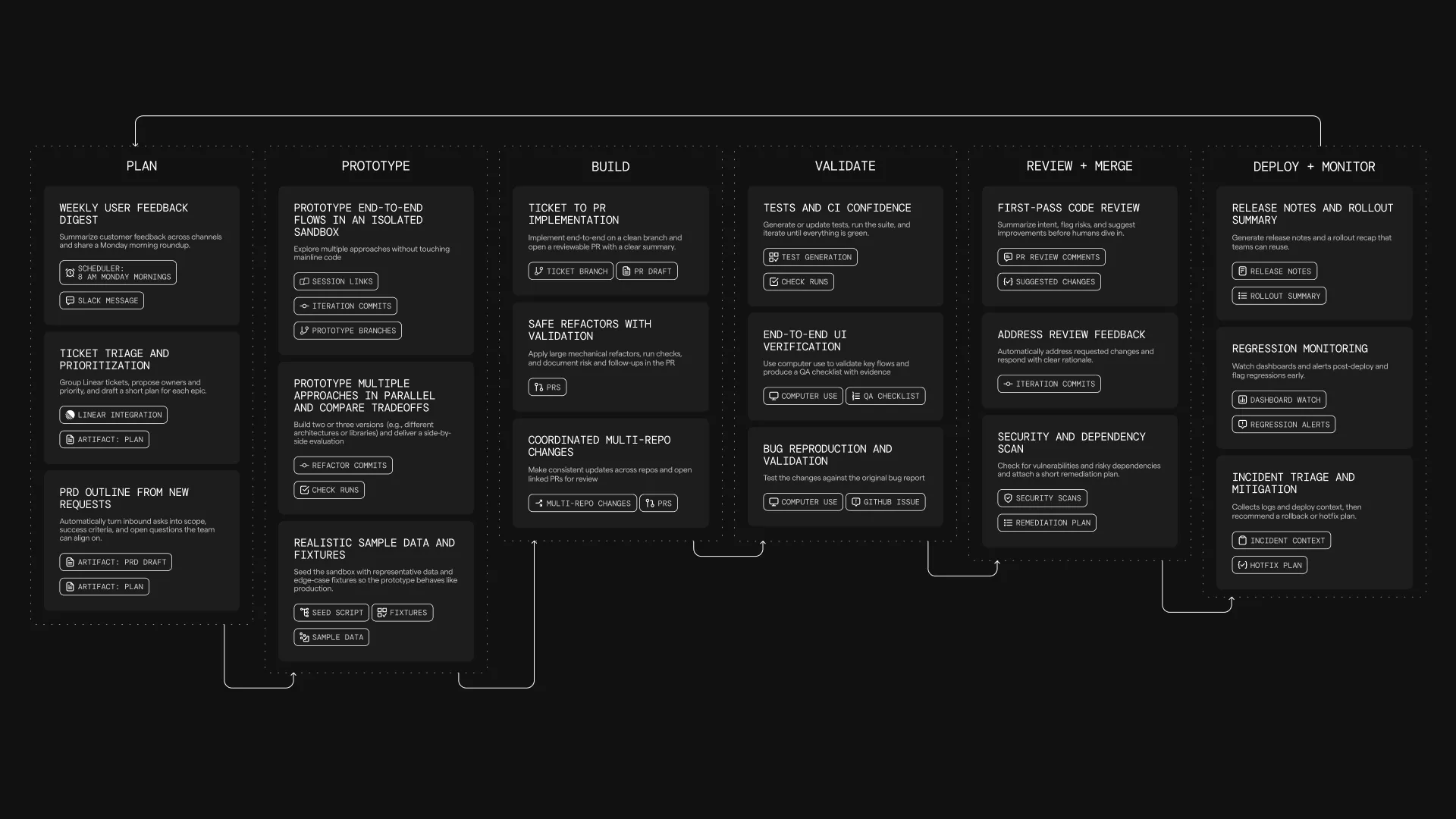
Cloud agents are autonomous, background agents that run on Warp’s cloud infrastructure or your own, triggered by system events, schedules, or integrations like Slack and GitHub. They execute tasks with full observability — every run is tracked, inspectable, and shareable across your team.
New to cloud agents? Start with the Cloud agents quickstart to run your first cloud agent in ~10 minutes.
For a standing, multi-stage workflow with named agents, automations, and measurement, use Warp Factories. The factory-specific setup and operations guidance complements this shared cloud-agent reference.
Monitor, inspect, and share cloud agent runs
Section titled “Monitor, inspect, and share cloud agent runs”To understand what a cloud agent did, start from the Agent Management Panel in the Warp app or the Runs page in the Oz web app. From there, you can find a run by source, status, trigger, or owner; open the run transcript; inspect the prompt, plan, commands, logs, and output; and share the session link with teammates for review.
For a full walkthrough, see Viewing cloud agent runs. If the run came from Slack, Linear, GitHub Actions, a schedule, the CLI, or the API, it still produces a reviewable cloud agent run record.
What cloud agents are designed for
Section titled “What cloud agents are designed for”Cloud agents are designed for situations where:
- You need agents to react to system events.
- Examples include crashes, bug reports, Slack interactions, cron timers, or CI steps.
- You want observability into agent activity across a team or system.
- This includes being able to see what ran, when it ran, what triggered it, what the agent did, and how teammates can review or share the result.
- You need more parallelism than local execution typically allows.
- For example, multi-agent orchestration can run many agent tasks concurrently in the cloud, shard a repo-wide task into multiple runs, or fan out the same task across multiple targets.
- You want agents to operate continuously as part of engineering infrastructure.
- This includes scheduled maintenance tasks and integration-driven automation.
What is a cloud agent run?
Section titled “What is a cloud agent run?”A cloud agent run is represented as an agent task. A task is created when a trigger fires (for example a webhook event or schedule) or when a user starts a run explicitly.
Each task includes:
- Inputs: a prompt, and often additional context from the triggering system (for example a Slack message, PR metadata, or CI logs).
- Execution context (optional): an Environment that defines the repo, image, and startup commands the agent should run with.
- Lifecycle state: created → running → completed / failed.
- Persistent record: status, metadata, and a session transcript that can be reviewed after the task completes, including the prompt, plan, commands, logs, outputs, and follow-up messages where available.
How cloud agents work
Section titled “How cloud agents work”Cloud agents run on the Automation Platform, which provides the primitives for triggering work, orchestrating tasks, executing agents (optionally in environments), injecting secrets, and inspecting results.
- Something triggers an agent task.
- The orchestrator creates and tracks the task.
- The agent executes on a host, optionally inside an environment, with whatever secrets and credentials it needs.
The exact way tasks are triggered and executed depends on your deployment model. Deployment patterns covers Warp-hosted and managed self-hosted execution for factories. For standalone agents, see unmanaged execution.
For teams that need execution to stay within their network boundary, self-hosting supports two architectures: a managed worker daemon that lets the Automation Platform orchestrate agents in Docker containers on your machines, and an unmanaged mode where you run oz agent run directly in your CI, Kubernetes, or dev environment. See Self-hosting for details.
What you get by default
Section titled “What you get by default”Because cloud agents run on the Automation Platform, each run is tracked and produces a persistent record that can be observed, shared, and reviewed (even if execution happens outside the Warp app).
Codebase Context
Section titled “Codebase Context”Cloud agent runs automatically benefit from Codebase Context for semantic code understanding and search, as long as Codebase Context is enabled for your account. See Codebase Context in cloud agent runs for details.
Observability and steerability
Section titled “Observability and steerability”Cloud agent tasks are designed to be inspectable by the team:
- The Agent Management Panel in the Warp app and the Runs page in the Oz web app surface task status, source, trigger, creator, history, and credit usage.
- Cloud agent session sharing opens the run transcript so teammates can inspect the prompt, plan, commands, logs, files changed, outputs, and follow-up messages where available.
- Agent Session Sharing lets authorized teammates share, monitor, and steer live local or third-party agent sessions.
Centralized configuration
Section titled “Centralized configuration”Cloud agent workflows often rely on shared configuration such as MCP servers, rules, saved prompts, environment variables, and secrets.
Warp supports centralized configuration so the same workflow behaves consistently across triggers (for example Slack + CI + schedules), without duplicating setup in every system.
For details on configuring MCP servers for cloud agents, see MCP Servers.
API access to tasks
Section titled “API access to tasks”The Automation Platform exposes task visibility via the Warp Platform API, so teams can:
- Query which tasks are running or have run.
- Fetch task metadata and outcomes.
- Build internal dashboards or monitoring (for example success rates, runtime, failure reasons).
Using cloud agents with or without the Warp app
Section titled “Using cloud agents with or without the Warp app”Cloud agents do not require the Warp app. Teams can deploy and operate them through the Automation Platform using:
- Oz CLI — run agents from scripts, CI, or the terminal
- Oz web app — visual interface for managing runs, schedules, environments, and integrations (works on mobile)
- Agent Session Sharing — attach to running tasks to monitor or steer
- Agent Management Panel — view agent activity and run history in the Warp app
- APIs and SDKs — programmatic access for custom integrations
If your team also uses Warp’s terminal, you get an additional workflow: tasks launched via the CLI can be handed off into an interactive session for review, edits, or continuation.
Billing and plan requirements
Section titled “Billing and plan requirements”Cloud agents and integrations run on the Automation Platform control plane, and usage is billed using credits.
For cloud agents via CLI/API
Section titled “For cloud agents via CLI/API”Individual users can run cloud agents without being on a team. Requirements:
- You need at least 20 credits available
- Cloud agents run on Warp-hosted infrastructure
- Self-hosted agents require a team subscription
For integrations (Slack/Linear)
Section titled “For integrations (Slack/Linear)”Integrations require you to be part of a Warp team and additional requirements:
- Plan requirements
- Supported plans: Build, Max, Business
- Your plan must support add-on credits.
- Credit requirements
- Your team must have at least 20 credits available to run cloud agents and integrations.
For more details, see Access, Billing, and Identity Permissions.
Learn more
Section titled “Learn more”- Cloud agents quickstart — run your first cloud agent with an environment in ~10 minutes.
- Automation Platform — CLI, Warp Platform API, orchestration, tasks, environments, hosts, integrations, and more.
- Warp Factories — assemble cloud agents into a standing triage-to-merge workflow with named agents, automations, and measurement.
- Harnesses — pick between Warp Agent, Claude Code, and Codex for any cloud agent run.
- Agents — cloud agents that own and execute runs on your team.
- Multi-agent orchestration — coordinate a parent agent and its child agents across local and cloud runs to build supervisor/worker, fan-out, critic, DAG, and swarm workflows.
- Skills as Agents — run agents based on reusable skill definitions from the CLI, web app, API, or on a schedule.
- Oz CLI — shows how to run agents in non-interactive mode from CI, scripts, or remote machines, including auth and common commands.
- Environments — explains how environments provide the runtime context (repo, image, startup commands) for agent tasks.
- Warp Platform API — documents the REST API for creating, querying, and monitoring agent tasks programmatically.
- Agent Secrets — covers how to store, scope, and inject credentials into agent runs safely.
- MCP Servers — how to configure MCP servers for agent tool access and how MCP configuration is applied across runs.
- Deployment Patterns (beta) — compares common ways to deploy cloud agents and when to use each.
- Access, Billing, and Identity Permissions — explains individual and team-level requirements, credit billing behavior, and the permission model for who can run, view, and steer cloud agent tasks.