Interacting with Agents
Warp organizes your Agent interactions into conversations tied to sessions, allowing you to attach context blocks, follow up on previous queries, or begin new threads for distinct tasks.
Conversations with Warp's Agent
Conceptually, a conversation is a sequence of AI queries and blocks. Conversations are tied to sessions and you can run multiple Agent Mode conversations simultaneously in different windows, tabs, or panes.
Conversations work best when the queries are related. If your new question builds on the last one, continue in the same conversation. If it is unrelated, it is better to start a new one so that the context remains relevant.
Long conversations can cause slower performance and lower-quality answers. When working on a separate task or question, start fresh rather than relying on context from earlier interactions.
To access conversations across devices, share them with teammates, or restore past cloud Agent conversations, enable Cloud-synced Conversations.
Staying in a conversation (follow-ups)
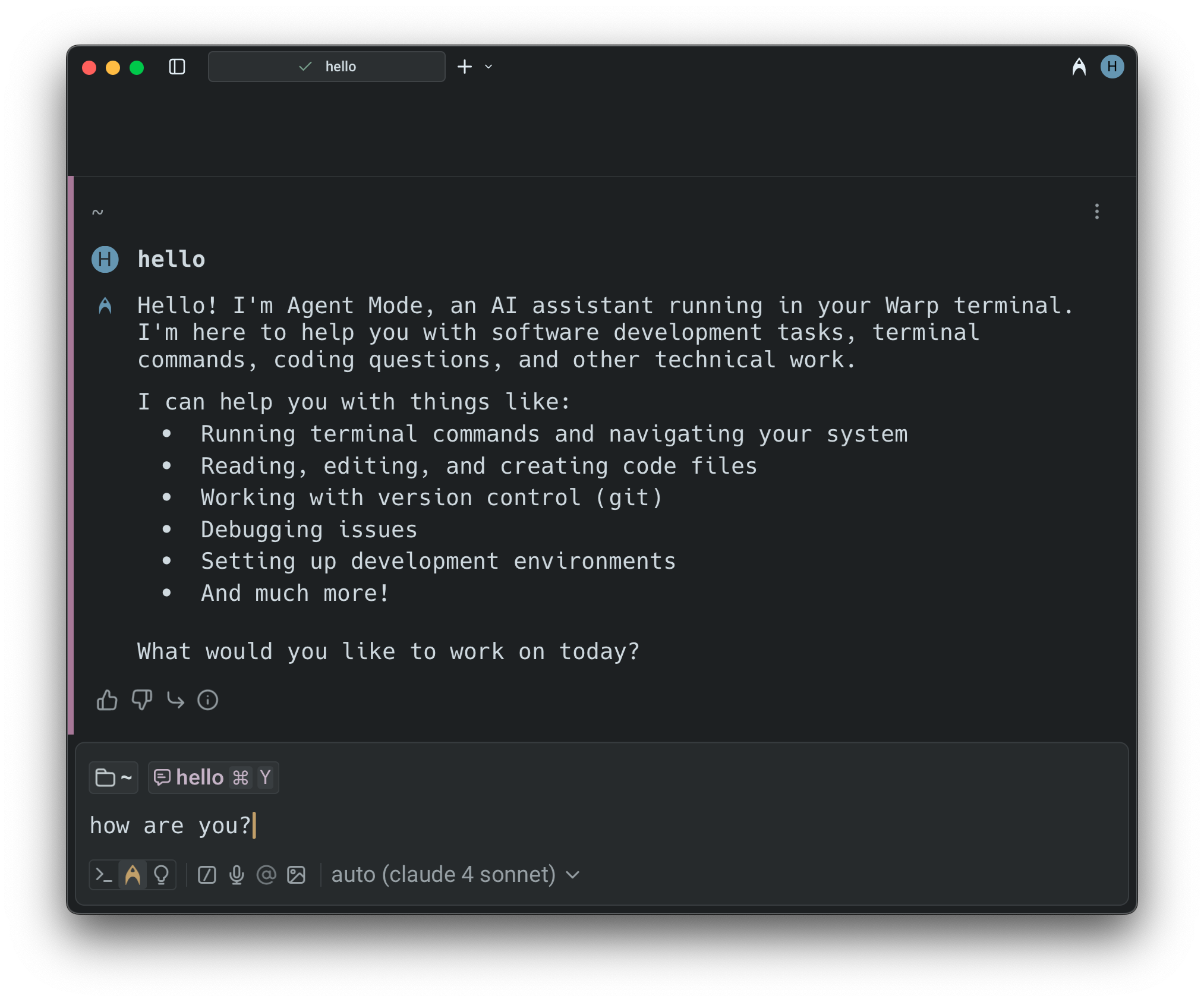
By default, if you ask an AI query immediately after interacting in Agent Mode, your query is sent as a follow-up to the current conversation.
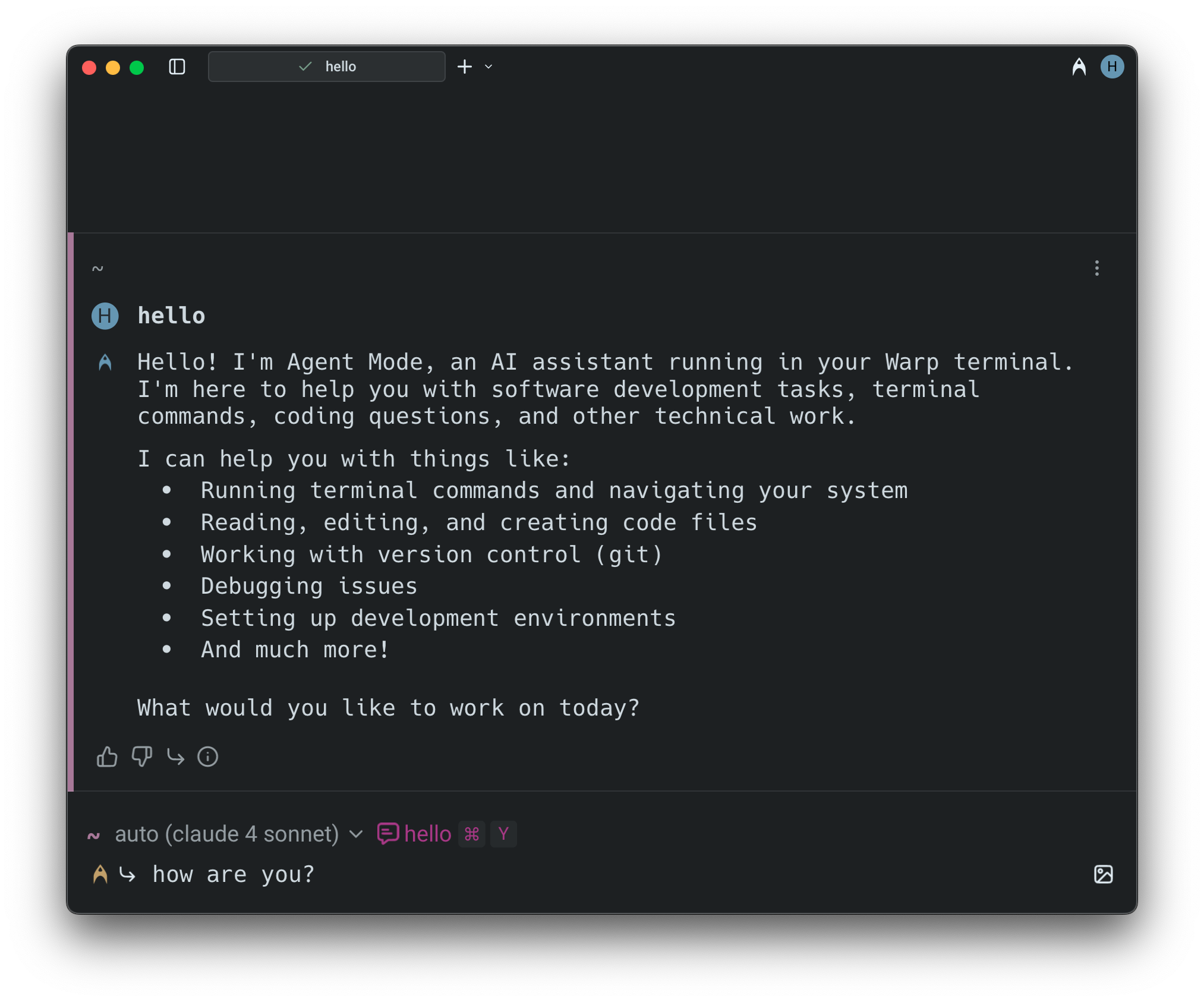
In Classic Input, you'll see both the pink highlight bar on the left side of the block and a bent follow-up arrow (↳) next to your input. The conversation input chip also shows which conversation you are in.
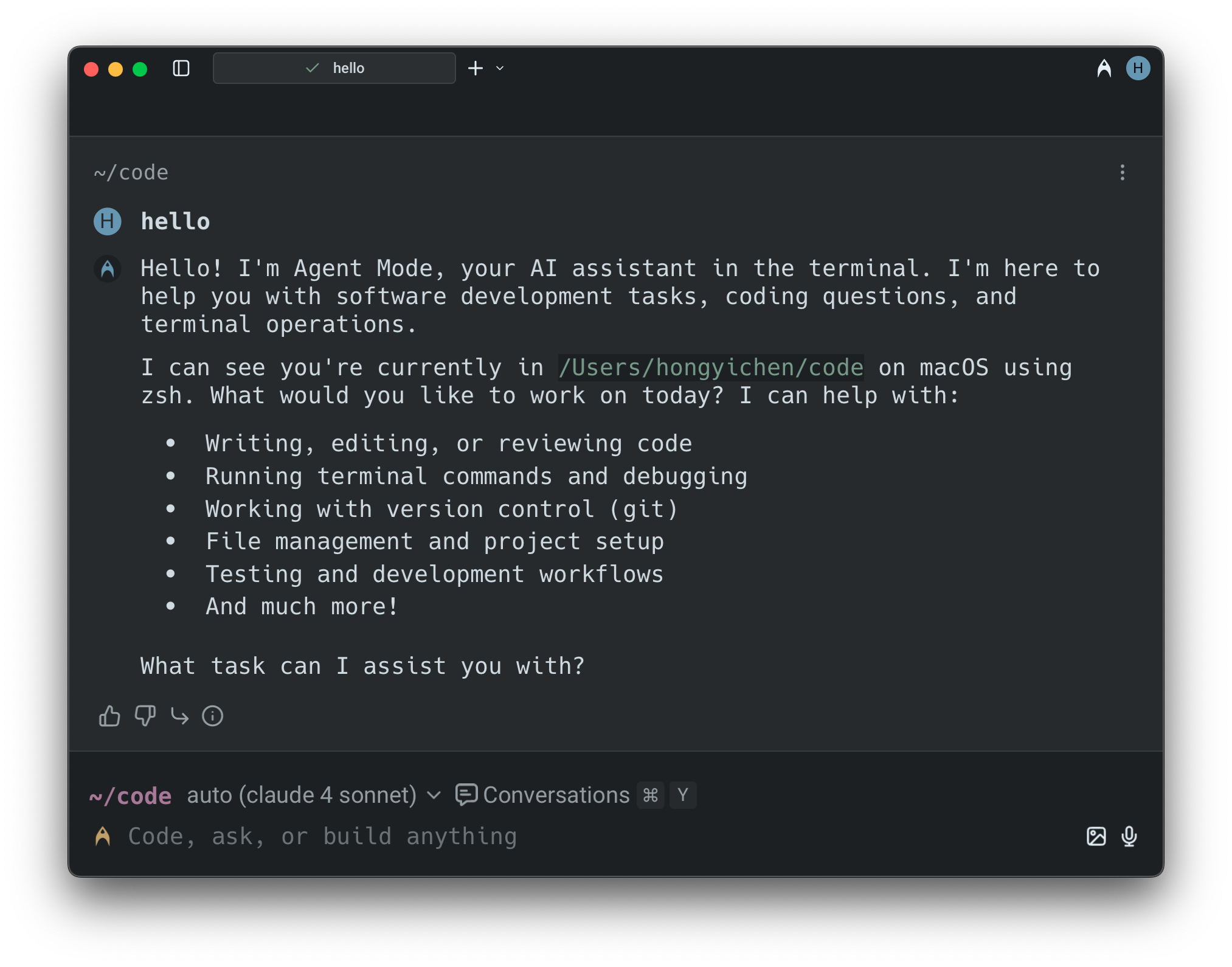
In Agent Modality (the default), the conversation view provides a dedicated space for multi-turn interactions. The conversation panel shows which conversation you are in.
To follow-up on a previous conversation:
Simply continue prompting the agent if you are already in an active conversation.
Open the Conversations menu (
CMD + Yon macOS,CTRL + SHIFT + Yon Windows/Linux), select a conversation, and then enter your query.Alternatively, click the pink conversation chip in the input field to resume.


Agent tips in the input
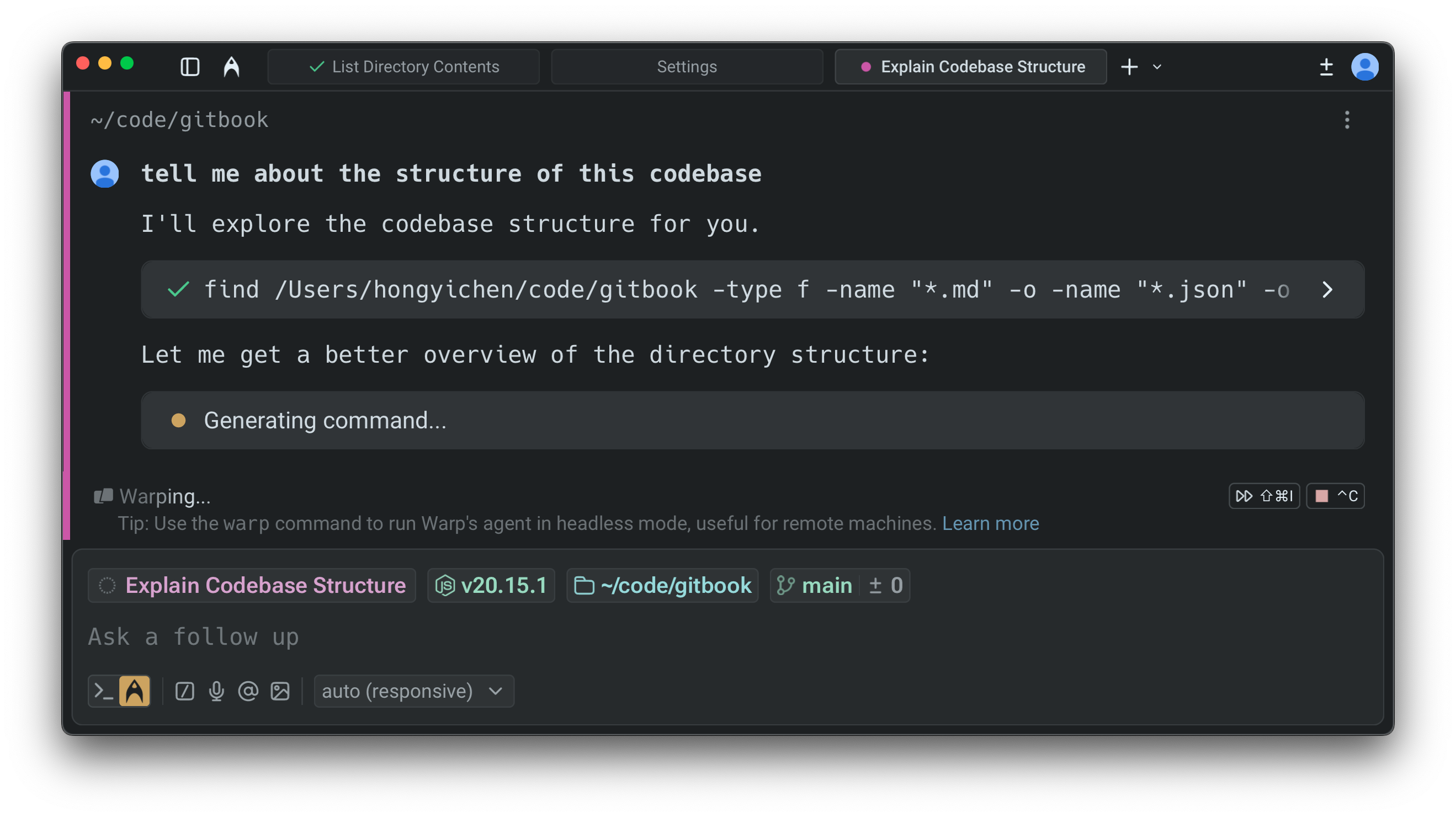
While Warp’s agent is thinking and processing your request, Warp may surface short tips with helpful workflows and ways to use Warp. These tips appear under the Warping indicator.

You can enable or disable these tips in two places:
Settings:
Settings>AI>Input>Show agent tipsCommand Palette: Open the Command Palette (
CMD + Pon macOS,CTRL + SHIFT + Pon Windows/Linux), then select "Show Agent Tips" or "Hide Agent Tips"
Managing conversations
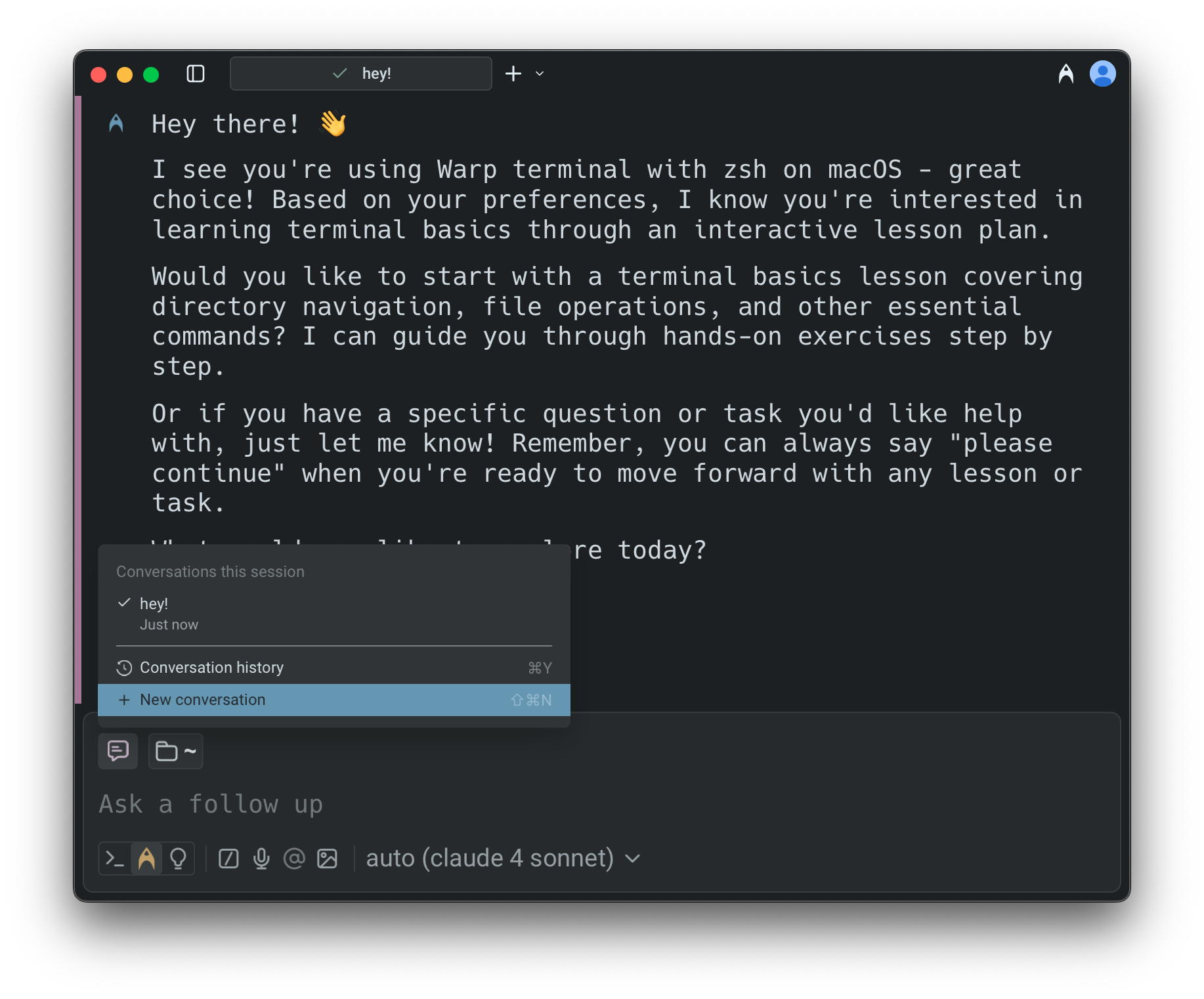
You can view previous conversations or start a new conversation via the Conversations Menu (CMD + Y on macOS, CTRL + SHIFT + Y on Windows/Linux).
The "New Conversation" item disappears once you start searching for an actual conversation.
Starting a new conversation
Warp automatically creates a new conversation in a few situations. For example, if you ask an AI query after running a shell command or if three hours pass without activity, Agent Mode will start a fresh conversation.
Visual indicators differ slightly depending on input mode:
In Classic Input, a new conversation begins when there is no follow-up arrow (↳) next to your input.
In Agent Modality, starting a new conversation opens a fresh conversation view. Use the conversation panel to see all active and past conversations.
You can also start a new conversation manually at any time:
In Classic Input, press
CMD + Ior pressBACKSPACEwhile in follow-up mode.In Agent Modality, press
CMD + ↵to start a new conversation, or use the/newslash command.Open the Conversations Menu using
CMD + Yand select "New Conversation".
You can also start a new conversation manually at any time:
In Classic Input, press
CTRL + Ior pressBACKSPACEwhile in follow-up mode.In Agent Modality, press
CTRL + SHIFT + ↵to start a new conversation, or use the/newslash command.Open the Conversations Menu using
CTRL + SHIFT + Yand select "New Conversation".
You can also start a new conversation manually at any time:
In Classic Input, press
CTRL + Ior pressBACKSPACEwhile in follow-up mode.In Agent Modality, press
CTRL + SHIFT + ↵to start a new conversation, or use the/newslash command.Open the Conversations Menu using
CTRL + SHIFT + Yand select "New Conversation".


Context Window Management
Every conversation with an agent consumes tokens stored in a context window. The context window (sometimes called context length) is the amount of text (measured in tokens) that a Large Language Model (LLM) can process at one time. The size of the context window depends on the model you are using.
As tokens accumulate and exceed the context window, performance and response quality may degrade. If the context window is exceeded, the model may lose track of earlier parts of the conversation, and Warp will automatically summarize the conversation to free up space.
Warp provides a context window usage indicator to help you track this:
When less than 20% of the window is used, no indicator is shown. As more tokens accumulate, the usage bar progresses to reflect how much of the context window has been consumed.


As you approach the limit, the indicator turns red to warn that the context window is nearly full.

Once the limit is exceeded, Warp automatically summarizes the conversation so you can continue without losing important context.

The context window usage indicator is available in agent conversation views.
If you switch models during a conversation, the context usage indicator updates only after you send your next message.
Conversation segmentation
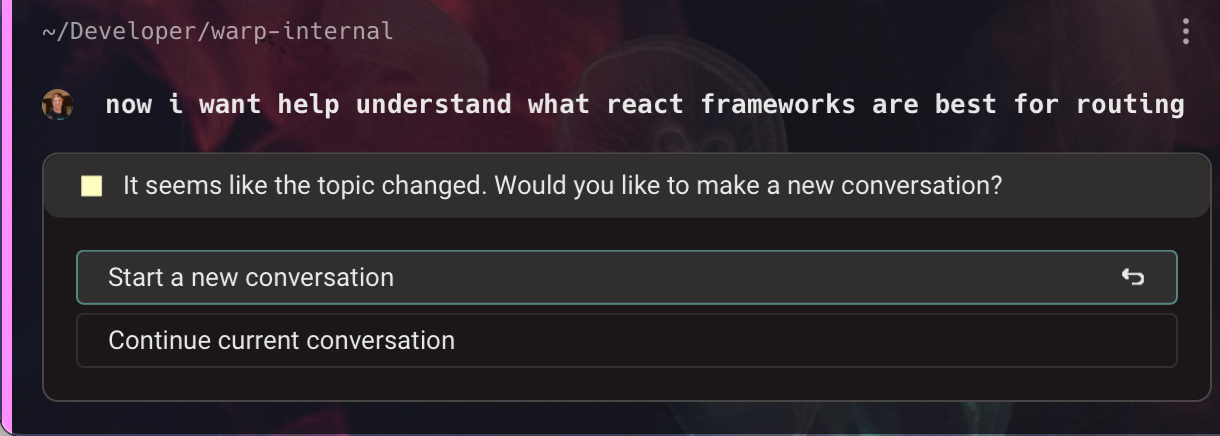
Warp automatically detects when your query has shifted to a new topic. When this happens, it suggests starting a new conversation instead of continuing in the same context.
These options appear in the blocklist, where you can decide whether to branch off into a new conversation or keep going with the current one.

You can also create a new conversation manually at any time by using the keyboard shortcut, opening a new tab, or opening a new pane.
Start a new conversation:
CMD + SHIFT + NOpen a new tab:
CMD + TOpen a new pane:
CMD + D
Start a new conversation:
CTRL + SHIFT + NOpen a new tab:
CTRL + SHIFT + TOpen a new pane:
CTRL + SHIFT + D
Start a new conversation:
CTRL + SHIFT + NOpen a new tab:
CTRL + SHIFT + TOpen a new pane:
CTRL + SHIFT + D
Conversation Panel
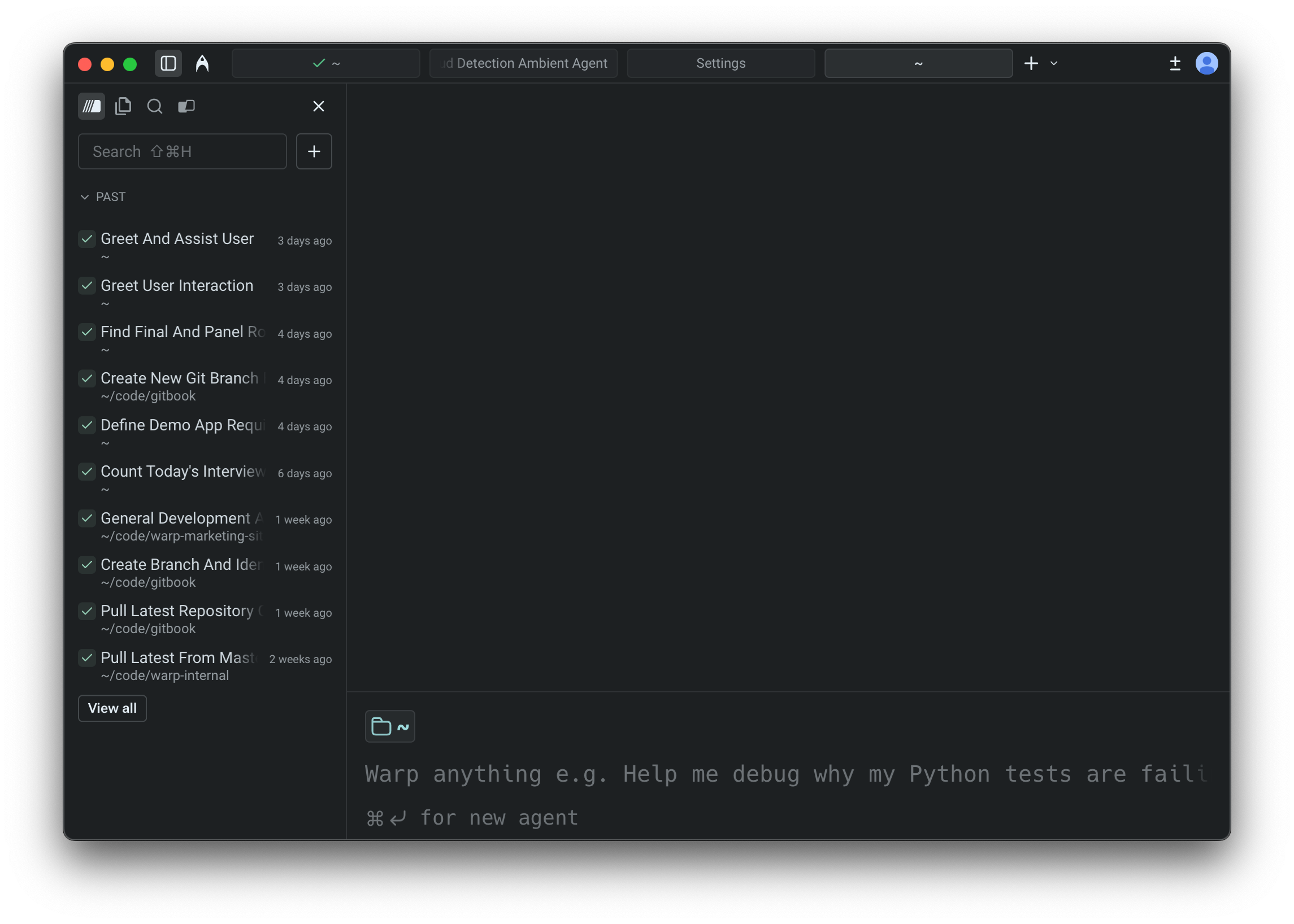
The Conversation Panel on the left side of the window is the home for browsing and switching between agent conversations. It's designed to make multi-threaded work obvious: you can see what's active, what you ran recently, and jump back into any thread without guessing where your context went.

Panel layout
The conversation panel is split into two dropdowns (collapsible sections) that help you navigate between conversations:
Active
The Active dropdown lists the conversations that are currently open in this window/workspace.
Select a conversation to switch to it immediately.
The conversation you're currently viewing is highlighted.
Past
The Past dropdown lists your recent conversation history.
Each row typically shows:
Conversation title
When it happened (for example, "8 min ago", "3 days ago")
Working directory (when relevant)
Use Past to restore a previous conversation. When you select a past conversation, Warp reopens it in a new tab or your active pane, letting you continue where you left off.
Conversation storage
By default, your agent conversations are stored locally on your machine. You can optionally enable cloud-synced conversations to:
Access your conversation history across different devices
Share conversations with teammates
Retain conversations when you log out or switch machines
For full details on enabling cloud sync, sharing conversations, and accessing cloud agent conversations, see Cloud-synced Conversations.
To enable cloud sync, go to Settings > Privacy and toggle on "Store AI conversations in the cloud". When disabled, conversations are stored locally only and cannot be shared. Note that cloud agent conversations are always stored in the cloud regardless of this setting.
Search
Use the search field at the top of the conversation panel to quickly find your conversation.
Type to filter conversations by title (and, in some builds, by directory/context).
Useful when you have many threads and want to jump directly to one.
New conversation
Click the New conversation button at the bottom of the Active conversation list to start a new conversation.
Starting a new conversation creates a fresh thread in the Active dropdown, without deleting or overwriting your previous ones.
Navigation behavior
In Agent Modality, navigation between terminal mode and agent conversations is designed to be direct:
Clicking an active conversation - Takes you directly to that conversation view.
Clicking a past conversation - Opens the conversation in a new pane, preserving your current context.
Command Palette - Open the Command Palette and type
conversations:to filter and navigate directly to any conversation.⌘Yconversation selector - Opens a dedicated menu showing your existing and past conversations. This works in both terminal view and agent view.Up-arrow history - Shows both past shell commands and past prompts you've sent in recent conversations. The behavior differs by context:
In terminal view - Shows both past shell commands and recent conversations.
In agent view - Shows past prompts you've sent in conversations.
Ways to move around
Use esc or the back button to return to terminal mode, ⌘Y to open the conversation selector, or ⌘↩ to start a new conversation. For a complete list of keyboard shortcuts and slash commands, see Agent Modality - Keyboard shortcuts.
Exit confirmation for in-progress conversations
Exiting a conversation that is still in progress will cancel the agent's current work. To prevent accidental cancellations, Warp shows a confirmation hint:
First exit attempt - The hint changes to "Press again to exit" (or similar).
Confirmation window - You have about 2 seconds to press
escor^Cagain to confirm.After confirmation - Warp exits the conversation and cancels the in-progress request.
This confirmation step ensures you don't accidentally lose work when the agent is mid-task.
Empty new conversations (where you haven't sent any messages yet) can be exited immediately without confirmation.
Last updated
Was this helpful?